
Greater Houston · Harris, Fort Bend, Brazoria, Galveston, Montgomery
Houston EV Charger Installers: Level 2 Charging, Panel Upgrades & Standby Generators Across Greater Houston
We run the load calculation before we quote, pull the permit, and size the circuit to the charger you actually have.
- Level 2 permit
- $100.71
- Typical install
- $1,200–$3,000+
- Entergy rebate
- $250/port
- Panel upgrade
- $1,000–$5,000+
Request a quote
Your request has been submitted. We will review your project details and get back to you promptly.
Need an answer sooner? Call (346) 406-1223.
That did not send. Your details are still in the form, so you can try again.
Or call (346) 406-1223 and we will take them over the phone.
- 31+
- Cities served
- Across five counties
- 12
- Services
- Charging, panels, backup power
- Every job
- Permit and inspection
- Pulled by a registered master electrician
- 11+
- Years serving Houston
- Installing since 2015
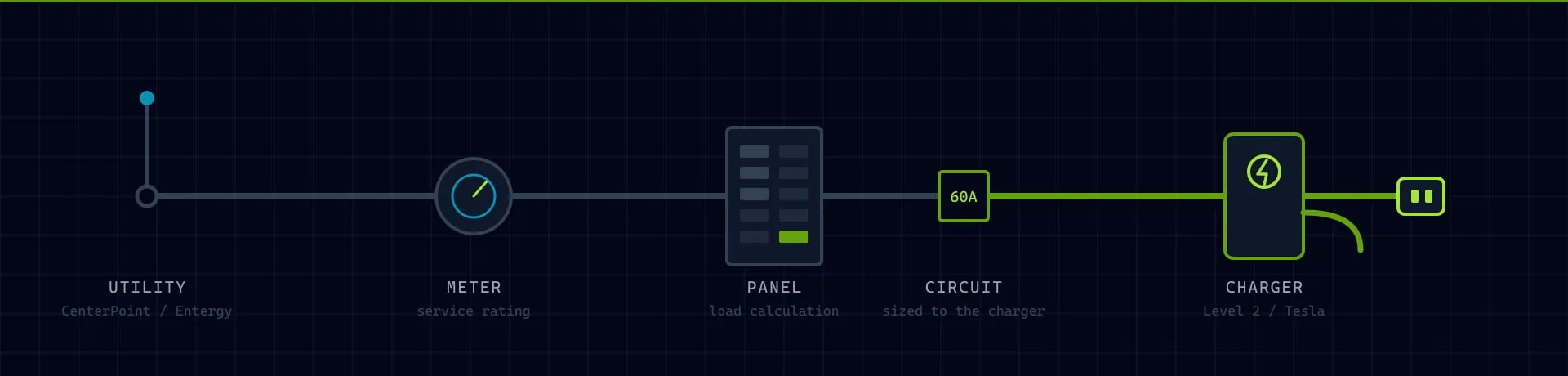
What we install
All 12 services — charging, the electrical work behind it, and backup power for when the grid goes.
Charging 4
Level 2 EV Charger Installation
A dedicated 240-volt circuit and mounted charger that takes a full-size EV or truck from empty to full overnight instead of over three days.
Most quotes go wrong before anyone touches a wire — the load calculation is skipped and the circuit is guessed. Start with the calculation.
Read moreTesla Wall Connector Installation
Hardwired Wall Connector installation with the circuit sized to the amperage you actually commissioned it at, not the maximum on the box.
A Wall Connector commissioned at an amperage the circuit cannot carry is the most common install error we're called back to correct.
Read moreNEMA 14-50 Outlet Installation
A 240-volt receptacle on a dedicated 50-amp circuit for a plug-in charger — the flexible option when you may move or change vehicles.
The cheap 14-50 receptacle from a big-box shelf is not rated for hours of continuous draw. It is the single most common cause of a scorched outlet.
Read moreHardwired EV Charger Installation
Direct-wired charger installation for higher amperage than a receptacle allows, and for outdoor locations where a plug connection is the weak point.
If your charger lives outside within a few miles of Galveston Bay, the plug is the part that fails first. Hardwiring removes it.
Read moreElectrical 1
Backup Power 3
Home Battery Backup Installation
Battery storage sized to carry the circuits that matter through a Houston outage, with the transfer equipment to switch over automatically.
After Uri and Beryl, the question stopped being whether the grid goes down and became which circuits you want still running when it does.
Read moreBidirectional Charging & Vehicle-to-Home
Equipment that lets a capable EV back-feed the house during an outage, turning the truck in the driveway into the largest battery on the property.
Not every EV can do this, and the ones that can need specific equipment. The compatibility check is the first call, not the last.
Read moreStandby Generator Installation
Permanently installed natural gas or propane standby generators with automatic transfer — for outages measured in days rather than hours.
Texas law is on your side here in a way it is not for EV charging — an HOA cannot simply prohibit a qualifying standby generator.
Read moreCommercial 2
Commercial EV Charger Installation
Multi-port charging for workplaces, retail, multifamily and fleet yards, including the service capacity study that has to come first.
Size the conduit for the build-out you want in five years. Re-trenching a parking lot costs more than the extra conduit ever did.
Read moreDC Fast Charger Installation
High-power DC charging for commercial and fleet sites — a utility infrastructure project as much as an electrical one.
The charger is rarely the long pole. The utility service is. Start that conversation months before you want to open.
Read moreService 2
EV Charger Repair & Maintenance
Diagnosis and repair for chargers that trip, fault, throttle, or stop communicating — including installs someone else did wrong.
A charger that trips every few sessions is telling you something about the circuit behind it. It is not a setting to adjust away.
Read moreEV Charger Relocation
Moving an existing charger for a garage remodel, a new vehicle with the port on the other side, or a move to a new Houston-area home.
Measure the cable against the new parking position before you commit to the wall. Reach decides the layout more often than anything else.
Read moreHow the job actually starts
The calculation comes before the quote
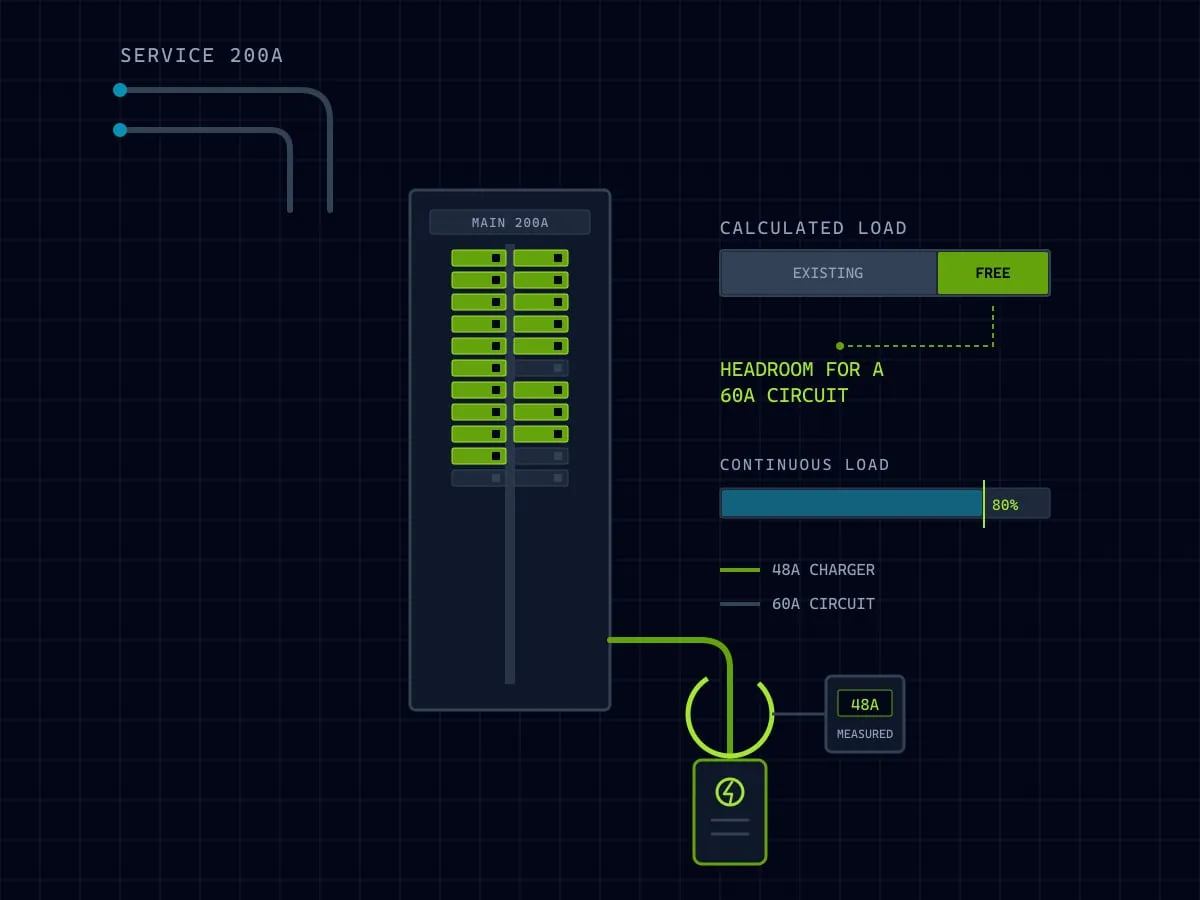
Most EV charger installations go wrong before anyone touches a wire. The load calculation gets skipped, the circuit is guessed from the number on the charger's box, and the difference surfaces months later as a breaker that will not hold.
A whole-home load calculation totals your fixed loads against the service rating and shows what is left. That single number decides whether your job is a circuit, a load-management device, or a service upgrade — three projects with very different costs.
It is a small piece of work, and it regularly finds that the panel upgrade someone quoted you is not necessary.
- Continuous load rule
- 80%
- of circuit rating
- 48A charger needs
- 60A
- circuit, not 50A
Chargers we install, by what you drive
Every EV sold in Texas, across 26 makes. The honest version: the electrical work does not change with the badge. The circuit, the panel capacity, the conduit and the permit are the same for a Cybertruck as for a Niro EV — only the plug on the end of the cable differs.
- Tesla
- Model 3 · Model Y · Cybertruck
- Ford
- F-150 Lightning · Mustang Mach-E · E-Transit
- Chevrolet
- Equinox EV · Blazer EV · Silverado EV
- Rivian
- R1T · R1S · R2
- Hyundai
- Ioniq 5 · Ioniq 6 · Kona Electric
- Kia
- EV6 · EV9 · Niro EV
- BMW
- i4 · iX · i5
- Mercedes-Benz
- EQB · EQE · EQS
- Audi
- Q4 e-tron · Q6 e-tron · e-tron GT
- Volkswagen
- ID.4 · ID. Buzz
- GMC
- Hummer EV · Sierra EV
- Cadillac
- Lyriq · Optiq · Escalade IQ
- Lucid
- Air · Gravity
- Porsche
- Taycan · Macan Electric
- Volvo
- EX30 · EX90
- Polestar
- Polestar 2 · Polestar 3
- Nissan
- Ariya · Leaf
- Toyota
- bZ4X
- Lexus
- RZ
- Subaru
- Solterra
- Honda
- Prologue
- Acura
- ZDX
- Genesis
- GV60 · GV70 Electrified
- Jeep
- Wagoneer S · Recon
- MINI
- Cooper SE · Countryman Electric
- VinFast
- VF 8 · VF 9
Driving something not listed? It is still a 240-volt circuit and a mounting position. Call (346) 406-1223.
Which plug do you need?
There are two AC connector standards in North America, and manufacturers are mid-transition between them. Your model year decides which one you have, not your make — the same nameplate can differ between a 2024 and a 2026.
NACS
SAE J3400Originally Tesla’s connector and now the North American standard. Manufacturers have been moving to it since 2025, so it is what most new vehicles arrive with.
J1772
SAE J1772The AC connector nearly every non-Tesla EV used before the change, and still what a large share of the cars on Houston roads have. Widely supported and going nowhere for years.
For home charging, this matters less than it sounds. Both standards carry the same power on the same circuit, and adapters bridge them in both directions. It decides which cable you buy — not the panel work, not the conduit, not the permit. Anyone quoting you a different price because of the badge on your car is pricing something other than the electrical work.
Vehicle makes and model names are trademarks of their respective manufacturers, listed here to describe the vehicles we install charging equipment for. We are an independent electrical contractor and are not affiliated with, endorsed by, or certified by any vehicle manufacturer.
Houston EV charging questions46 answers
Everything we get asked, in one place — costs, permits, panel capacity, hardware choices and local conditions.
Start here
How much does EV charger installation cost in Houston?
Most Level 2 installations run between $1,200 and $3,000 or more. Homes with panel capacity already available and a short run sit at the lower end. Homes needing a panel upgrade, a long trenched run to a detached garage, or coastal-rated equipment sit at the upper end and beyond.
Do I need a permit to install an EV charger in Houston?
Yes. Inside city limits it is permit type HPWCODE1056 at $100.71 for Level 2 plus a $33.56 administrative fee, with inspection required. The city issues electrical permits only to master electricians registered with it, so a homeowner cannot pull this permit themselves.
Will my existing panel handle a charger?
Often yes without any change, particularly in homes built after 2000. A whole-home load calculation is the only way to know, and it costs a fraction of the panel upgrade it frequently avoids. Houses from the 1960s and 1970s are where capacity is genuinely the constraint.
Do you install chargers for cars other than Tesla?
Yes — every EV make sold in Texas, including Ford, Chevrolet, Rivian, Hyundai, Kia, BMW, Mercedes-Benz, Audi, Volkswagen, Lucid, Volvo, Polestar, Nissan, Toyota and the rest. The electrical work does not change with the vehicle: the circuit, the panel capacity, the conduit and the permit are identical whether you drive a Cybertruck or a Niro EV. Only the plug on the end of the cable differs, and adapters bridge the two standards in both directions.
What is the difference between NACS and J1772 for home charging?
They are the two AC connector standards in North America. NACS, originally Tesla’s connector and now standardised as SAE J3400, is what most manufacturers have been moving to since 2025. J1772 is what nearly every non-Tesla EV used before that and what a large share of cars on Houston roads still have. Your model year decides which you have, not your make. For home Level 2 charging both carry the same power on the same circuit — the choice affects which cable you buy, not the panel work, the conduit or the permit.
Is there still a federal tax credit for home charging?
No. The federal 30C credit expired on June 30, 2026. Many charger pages still advertise it. If you are served by Entergy Texas rather than CenterPoint, a $250 per-port rebate is available for ENERGY STAR certified equipment.
Which cities do you cover?
We install across 31 cities in five counties — Harris, Fort Bend, Brazoria, Galveston and Montgomery. Which one you are in decides your permit office, your utility, and whether a rebate applies, so tell us the address early.
How long does an installation take?
A straightforward job with panel capacity already available is usually a single visit. What extends it is a panel or service upgrade, which involves the utility, or inspection scheduling, which belongs to your permit office rather than to us.
The work itself
How long does a Level 2 charger take to install?
A straightforward installation with panel capacity already available is usually a single visit. The variable is not the charger, it is the run length, whether the panel has room for a two-pole breaker, and whether an inspection has to be scheduled before the circuit is energized.
Do I need a permit for a Level 2 charger in Houston?
Yes. Inside city limits the work requires an electrical permit, and the City of Houston issues electrical permits only to master electricians registered with the city. A homeowner cannot pull this permit themselves. Unincorporated Harris County has required permits for this class of work since September 2009.
Can a Wall Connector charge a non-Tesla vehicle?
Yes, with an adapter. The Wall Connector uses the NACS connector, and vehicles with a J1772 inlet charge through an adapter. If your household runs a mix of vehicles, tell us before installation so the mounting position works for both charge port locations.
What is commissioning amperage and why does it matter?
The Wall Connector is configured during installation to a maximum current. That setting has to match the circuit it is wired to. A unit commissioned above what the circuit can carry will draw more than the conductors are rated for, and it is the most common installation error we are called back to correct.
Why does the receptacle brand matter?
Charging pulls near-maximum current for hours at a time, which is a duty cycle most commodity receptacles were never designed for. The inexpensive part sold for occasional RV or welder use heats at the terminals under that load. An industrial-specification receptacle uses better contact material and terminations.
How much can I actually draw from a 14-50?
A 50-amp circuit supports a 40-amp continuous load, because continuous loads are limited to 80 percent of circuit rating. Most portable chargers on a 14-50 are set to 32 or 40 amps for exactly this reason. A charger configured higher than that is misconfigured.
When do I need hardwiring instead of a 14-50 outlet?
Above 40 amps of continuous charging, because that is the ceiling a 50-amp receptacle circuit supports. Also when the manufacturer requires hardwiring for outdoor installation, and whenever the unit lives outdoors near Galveston Bay where a plug connection corrodes.
Do electric trucks actually need more than 40 amps?
They can use it. A full-size electric truck carries roughly double the pack capacity of a compact EV, so the same overnight window refills a smaller fraction of it. Households charging a Lightning, Silverado EV, Cybertruck or R1T on a tight schedule notice the difference between 40 and 48 amps.
How do I know if I really need a panel upgrade?
A whole-home load calculation answers it. It totals your fixed loads against the service rating and shows how much capacity remains. It is a small piece of work relative to an upgrade, and it regularly finds that the upgrade is unnecessary.
What is load management and when does it replace an upgrade?
Load management monitors household draw and reduces or pauses EV charging when the rest of the house is drawing heavily. It lets a charging circuit coexist with a service that could not otherwise carry it. Where the shortfall is modest, it is usually far cheaper than upgrading the service.
How long will a battery run my house?
It depends entirely on which circuits are backed up and what they draw. A battery carrying a refrigerator, lighting, internet and a few outlets lasts far longer than one asked to run central air conditioning. The sizing conversation is really a conversation about what you are willing to do without.
Battery or generator?
A battery is silent, needs no fuel, and starts instantly. A generator runs as long as it has gas, which matters when an outage stretches into days. Houston has had both kinds of event. Some households install both, with the battery covering short interruptions and the generator covering long ones.
Can my EV do this?
Not all can. Bidirectional capability depends on the vehicle, and among vehicles that have it, the required home equipment is often manufacturer-specific. The compatibility check is the first step, before any quote, because a no here saves you the rest of the conversation.
How long can an EV power a house?
Longer than most stationary batteries, because vehicle packs are larger — a full-size electric truck carries a multiple of a typical home battery. Actual runtime depends on backed-up circuits, state of charge, and whether you also need to drive somewhere during the outage.
Can my HOA stop me installing a standby generator?
Not outright. Texas Property Code Section 202.019 bars a property owners association from prohibiting or restricting a permanently installed standby generator that meets the statutory definition. The association may still regulate where it sits and how it looks, so the conversation is about placement and screening rather than permission.
What qualifies under that law?
The statute describes a generator powered by natural gas, liquefied petroleum gas, diesel, biodiesel or hydrogen, fully enclosed in the manufacturer's integral sound-attenuating enclosure, connected to the main panel through a manual or automatic transfer switch, and rated at not less than seven kilowatts. A portable unit on an extension cord is not covered.
How many ports can my site support?
Fewer than raw service capacity suggests if each port is sized at full rate, and considerably more if load management is designed in. The service capacity study gives the real number. Committing to a port count before that study is how commercial projects get repriced mid-build.
What drives operating cost on commercial charging?
Demand charges more often than energy charges. Utility commercial tariffs bill partly on the highest draw in a period, so several ports peaking together can cost more than the total energy consumed. Load management addresses this directly by flattening the peak.
Why does DC fast charging take so long to install?
The utility service is usually the long pole, not the charger. These units need three-phase power at a level most commercial sites do not already have, which can mean a transformer, switchgear and a utility service study. That work is measured in months.
What will it cost to operate?
Demand charges typically dominate, not energy. Commercial tariffs bill partly on the highest draw in a billing period, and a DC fast charger creates a very high instantaneous peak. Modelling that against the expected utilisation belongs in the decision, before equipment is ordered.
My charger trips the breaker every few sessions. What is wrong?
Usually the circuit rather than the charger. Repeated tripping points at conductors sized without correcting for temperature, a charger commissioned above what the circuit supports, or a connection that has loosened and is heating. Raising the breaker size is not the fix and makes it more dangerous.
My outlet is discoloured or smells hot. Is that urgent?
Yes. Stop using it. Discolouration or a burnt smell at a receptacle means heat damage at the terminals, and heat damage accelerates. It needs replacement, not tightening, and the circuit behind it needs checking for the cause.
Can I take my charger with me when I move?
A hardwired unit can be removed and reinstalled at the new address, which is electrical work at both ends. A charger plugged into a NEMA 14-50 unplugs, but the new house needs a matching circuit. Either way the destination needs its own load calculation.
My new car's charge port is on the other side. What are my options?
Extend or re-route the circuit to a better position, or reposition the charger where reach allows. Which is cheaper depends on the run. Before committing, park the new vehicle where it will live and measure the cable against the existing unit — sometimes it reaches.
Costs, permits and local conditions
What does an EV charger permit cost in Houston?
Under permit type HPWCODE1056, the published fees are $94.00 for Level 1, $100.71 for Level 2 and $107.42 for Level 3, plus a $33.56 administrative fee. Inspection is included and the permit is valid for 180 days.
How much does a panel upgrade cost in Houston?
Panel and service work in the Houston area runs roughly $1,000 to $5,000 or more. The spread is wide because three different jobs get quoted under the same heading: a panel replacement behind an adequate service, a full service upgrade involving the utility, or load management that avoids both. Establishing which one you need is what narrows the number.
Does Texas have a right-to-charge law?
No. Some states have statutes preventing an association from blocking EV charger installation. Texas is not one of them. Property Code Chapter 202 protects solar devices, standby generators and security measures, but contains no EV charging section.
Is the cheapest quote always cutting corners?
Not always. Sometimes it is a smaller operation with lower overhead doing correct work. The way to tell is not the total but whether the quote specifies the same job — circuit rating, conductor size, permit, and what the load calculation found.
Can a Tesla Wall Connector charge a non-Tesla EV?
Yes, using an adapter. The Wall Connector uses the NACS connector, and a vehicle with a J1772 inlet charges through an adapter. It works, but it adds a component that gets left in the other car.
What is the difference between NEMA 3R and 4X?
Both handle rain. 4X adds corrosion resistance, which is the property that matters near salt water. Inland Houston is fine on 3R; the bayfront cities are not.
Who honours the workmanship warranty on a network install?
Usually the network, administered centrally, with the work performed by a subcontracted local electrician. That can be fine. What to check is what happens if the subcontractor is no longer in the network when you call.
Can a homeowner pull an electrical permit in the City of Houston?
No. The city issues electrical permits only to master electricians registered with the City of Houston. That is a licensing structure rather than a policy preference, and it means a homeowner inside city limits cannot permit their own EV charger circuit.
How do I find my service rating?
It is usually printed on the main breaker at the top of the panel — commonly 100, 125, 150 or 200 amps. That number is your service rating. The number of empty breaker slots is a different thing entirely and does not tell you about capacity.
My charger trips the breaker occasionally. Is that normal?
No. Occasional tripping means something is marginal — usually a circuit sized without temperature correction, a charger commissioned above its circuit, or a connection that has loosened and is heating. It gets worse, not better.
Is one cheaper to install?
Not meaningfully. The circuit is the same work either way. A receptacle adds a part, hardwiring removes one, and the difference is small relative to the job. Choose on function rather than price.
Can I charge my EV from a portable generator?
Sometimes, at reduced rate, and it depends on the generator's output and how cleanly it produces power. It is a slow way to move energy and it is not what most portable units are sized for. Treat it as an emergency measure rather than a plan.
Is the dealership arrangement more expensive?
Sometimes, sometimes not. What is consistent is that it is a referral to a third party rather than work the dealer performs, so the quality depends on which contractor you are routed to rather than on the dealership brand.
Does clay movement really affect an electrical run?
Where the run crosses between structures that move independently, yes. A house slab and a detached garage slab do not move together, and a rigid conduit spanning them is loaded by the difference. Runs contained within one structure are largely unaffected.
Start with the calculation, not the quote
Tell us what you drive, where the car parks, and where your panel is. That is most of the answer.
Call (346) 406-1223